Anúncios
Working from home in a small apartment presents a specific challenge that larger homes don’t have: the complete absence of separation between work and personal life. When your desk is three feet from your bed, or when your dining table doubles as your office, the mental boundary between work mode and rest mode gets blurred in ways that affect both your productivity and your ability to genuinely decompress.
This guide is about building a home office setup that works in a small apartment — one that maximizes focus, minimizes clutter, and creates enough psychological separation between work and life to make both sustainable.
Choose a Dedicated Work Zone
The most important home office decision in a small apartment is not what equipment to buy — it’s where to put the work zone. And the principle is simple: wherever you work, that place should be used only for work. This creates a spatial association between the location and the mental state of working, which makes it easier to focus when you’re there and easier to mentally leave work when you step away.
Anúncios
Avoid working from your bed or sofa if at all possible. These are rest associations that make it genuinely harder to focus, and they also contaminate your rest spaces with work associations — making it harder to relax later.
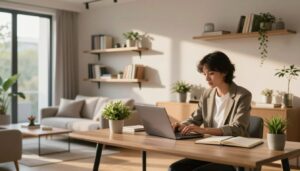
In a studio or one-bedroom apartment, the options are usually a dedicated desk in a corner of the living room, a wall-mounted fold-down desk that disappears when not in use, or a repurposed closet converted into a compact home office. Each of these works as long as the space is used consistently and exclusively for work.
The Desk: Get This Right First
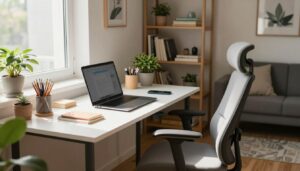
Your desk is the foundation of your work setup. In a small apartment, it needs to be the right size — large enough to work comfortably but not so large that it dominates the room and creates visual stress.
Anúncios
For most people working from home, a desk between 48 and 55 inches wide provides enough surface area for a monitor, keyboard, and working materials without taking over the room. Wall-mounted desks and floating shelves used as desk surfaces are excellent options for very tight spaces — they provide a dedicated work surface that can be folded away or visually separated from the rest of the room when the workday ends.
Ergonomics matter even in a small apartment. Your monitor should be at eye level, your chair should support your lower back, and your keyboard and mouse should be at a height that keeps your wrists neutral. Poor ergonomics lead to discomfort that becomes a constant low-level distraction. The Mayo Clinic’s office ergonomics guide is a reliable reference for getting the basics right.
Manage the Clutter on Your Desk
A cluttered desk is one of the most consistent sources of reduced focus. Visual clutter competes for attention in the same way digital notifications do — each object in your peripheral vision adds a small cognitive load that accumulates over a workday into genuine mental fatigue.
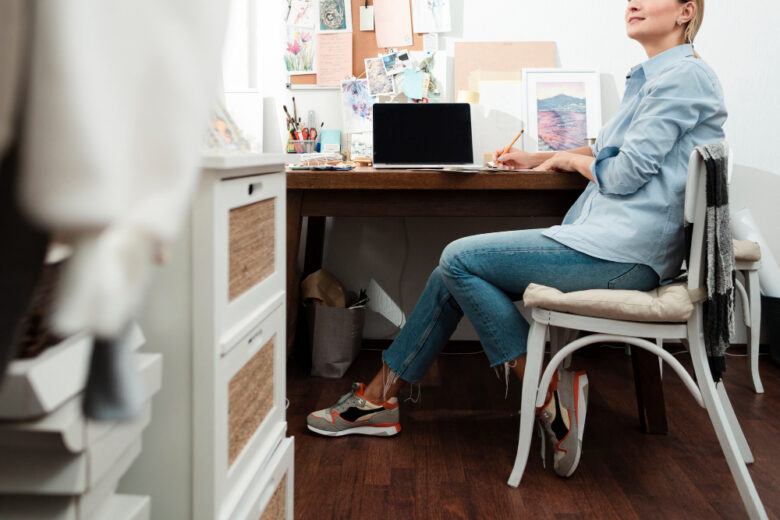
The goal is a desk surface that contains only what you are actively using. Everything else — papers, chargers, stationery, reference materials — should have a designated storage location off the desk surface. Desk organizers, small drawers, and wall-mounted storage within arm’s reach are all effective tools for this.
Cable management is often overlooked but makes a significant difference in how organized a workspace feels. A few cable clips, a cable management box for power strips, and Velcro ties for bundling cables behind the desk eliminate most of the visual noise created by tangled wires. Wirecutter’s cable management roundup covers the most effective products at different price points.
Control Your Lighting
Lighting has a direct effect on focus, eye strain, and mood during a workday. In a small apartment where natural light may be limited or inconsistent, getting your work lighting right is worth the small investment.
The ideal work setup has three light sources: natural light from a window positioned to the side (not directly behind or in front of your monitor), a desk lamp with adjustable brightness and color temperature for task lighting, and ambient room lighting that prevents a harsh contrast between your bright screen and a dark background.
Avoid relying solely on overhead ceiling lights for work. They create unflattering, flat lighting that increases eye strain during long sessions. A good desk lamp with warm to neutral white light (between 3000K and 4000K) positioned to illuminate your workspace without reflecting on your monitor is one of the highest-impact upgrades available for a home office setup.
Create a Start and End Ritual
In a traditional office environment, the commute serves as a psychological transition between home mode and work mode. When your commute is ten steps from your bedroom to your desk, that transition doesn’t happen automatically — you have to create it deliberately.
A start ritual is a short, consistent sequence of actions that signals the beginning of the workday. It could be as simple as making coffee, doing a brief review of the day’s priorities, and clearing your desk. The specifics matter less than the consistency — the ritual works because it becomes a reliable cue that shifts your mental state into work mode.
An end ritual is equally important. Physically shutting down your computer, clearing your desk, and doing a brief note of what you’ll pick up tomorrow creates a clear endpoint to the workday — something that working from home otherwise lacks. Without a clear end, work has a way of bleeding into evenings and weekends in a way that erodes both productivity and rest.
Manage Noise in a Small Space
Small apartments are rarely quiet. Street noise, neighbors, and the general ambient sound of urban living can make sustained focus difficult without some form of acoustic management.
Noise-cancelling headphones are the single most effective tool for focus in a noisy environment. A good pair removes ambient noise without requiring a perfectly quiet room. For calls, a headset with a microphone close to the mouth produces far better audio quality than built-in laptop microphones — an important detail if your work involves frequent video calls.
For background audio while working, many people find that ambient sound or instrumental music supports focus better than silence. Brown noise and lo-fi playlists are popular options. myNoise is a free tool that generates customizable ambient soundscapes for focus and concentration.
Conclusion
A productive home office in a small apartment is less about having the perfect equipment and more about creating the right conditions — a dedicated space, a clean desk, good lighting, and clear rituals that separate work from the rest of your day.
The investment in getting this right pays dividends every single workday. A well-designed home office in a small apartment makes focused work easier, protects your personal time, and turns a cramped space into something that genuinely supports the way you work.

I’m Daniel Carter, a designer based in Chicago with a passion for making small spaces work smarter. After years of living in cluttered apartments, I started experimenting with simple, low-cost organization systems that actually stuck. At Daily Dicas, I share what worked for me — practical tips for anyone who wants their home to feel calmer, more functional, and more intentional.