Anúncios
Small closets are among the most universally complained-about features of apartment living. The standard configuration — a single hanging rod, a shelf above, and a floor you can’t see — was designed with minimal thought for how people actually use their clothing storage. The good news is that with a few inexpensive additions and a clear system, even the smallest closet can be transformed into organized, functional storage that makes getting dressed easier rather than harder.
Start With a Complete Clear-Out
Organizing a small closet without first reducing its contents is an exercise in rearranging the problem. A closet that is genuinely too full for its contents cannot be organized into functionality — it can only be made to look slightly more organized while remaining fundamentally overcrowded.
Before doing anything structural, pull everything out of the closet and sort it honestly. Anything that doesn’t fit, hasn’t been worn in the last year, or that you genuinely don’t like goes into a donation or discard pile. Only what remains — what you actually wear — goes back in. For most people, this step alone makes a dramatic difference in how much space is available and how easy the closet is to use.
Anúncios
Assess Your Storage Needs Before Adding Anything
Before adding any storage solutions, spend five minutes thinking about what you actually need to store. How much of your wardrobe needs to hang versus fold? Do you have more shoes than the floor can handle? Do you need more drawer space for folded items? Is the shelf above the rod being used effectively?
The answers to these questions should drive every decision about what to add. A closet full of hanging clothes needs a different solution than one full of folded sweaters and shoes. Buying generic closet organizers without this analysis often results in solutions that don’t match the actual problem.
The Double Hang: The Single Most Impactful Change
The most effective upgrade for a small closet with a single hanging rod is adding a second rod below it. Short hanging items — shirts, jackets, folded trousers — only need about 40 inches of vertical clearance. A standard closet provides 60 to 70 inches of clearance, meaning the lower 20 to 30 inches below short hanging items is completely wasted.
Anúncios
A hanging double rod — a secondary rod that hooks onto the existing rod and hangs below it — adds a complete second tier of hanging space with no tools and no permanent installation. The upper rod handles longer items like dresses, coats, and full-length trousers. The lower rod handles shorter items. Usable hanging capacity roughly doubles.
For closets with a full-length section and a shorter section already built in, the shorter section is the right place to add a second rod below — maximizing every inch of hanging space available.
Maximize the Shelf Above the Rod
The shelf above the hanging rod in most closets is used as a dumping ground — a chaotic stack of bags, boxes, and items that don’t have anywhere else to go. With a small investment of organization, this shelf becomes genuinely useful storage.
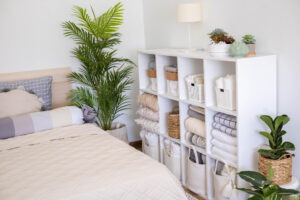
Use uniform bins or boxes with labels to contain categories of items on the shelf: seasonal clothing, spare bedding, bags and purses, out-of-season shoes. Uniform containers make the shelf look intentional rather than chaotic, and labels mean you can find what you need without pulling everything down to look.
If the shelf has enough depth, a second shelf can sometimes be added above the first using simple shelf brackets and a piece of cut wood or a pre-made shelf from a hardware store. This works particularly well for storing folded items, smaller bins, and accessories that don’t need as much vertical clearance as larger boxes.
The Floor: Use Every Inch
The closet floor is typically either completely unused or a pile of shoes and fallen items. Neither is acceptable in a small closet.
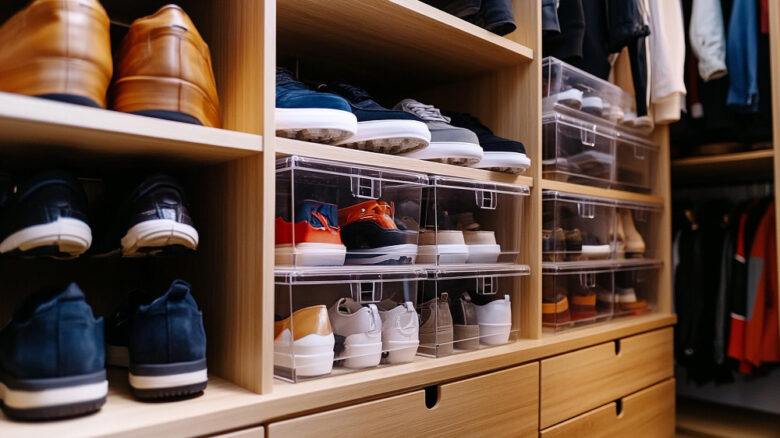
A tiered shoe rack uses vertical space on the floor efficiently and keeps footwear organized and visible. For closets with very limited floor space, an over-the-door shoe organizer moves shoes entirely off the floor and onto the back of the door — a particularly effective solution in small closets where every inch of floor space is needed for other storage.
Stackable storage drawers on the floor work well for folded items — underwear, socks, workout clothes — that don’t need to hang but currently don’t have a drawer to live in. These are especially useful in apartments without a dresser, where the closet needs to handle all clothing storage. The Container Store’s closet section is a useful resource for comparing different floor storage systems by size and price.
The Back of the Door
The back of a closet door is storage space that goes completely unused in most apartments. An over-the-door organizer transforms it into accessible storage for shoes, accessories, small bags, scarves, or any other items that need a home but don’t have one.
Over-the-door hooks are particularly versatile — a simple row of hooks handles bags, belts, and frequently worn items that you want accessible without taking up rod space. For jewelry and accessories, a clear pocket organizer mounted on the door makes everything visible at once without requiring a separate jewelry organizer.
Maintaining a Small Closet
Small closets return to disorder faster than large ones because there is less margin for error. A few items out of place in a large walk-in wardrobe are barely noticeable. The same few items in a small closet block access to everything else and make the space feel chaotic immediately.
The maintenance habit is simple: everything goes back to its designated place when it’s not being worn. Clothes that are clean but not ready to put away — worn once, not dirty — get a specific hook or section of the rod rather than ending up draped over a chair. This one habit prevents the “clean pile” that gradually takes over the closet floor and all adjacent surfaces. Apartment Therapy’s guide to maintaining a small closet covers additional daily habits worth adopting.
Conclusion
A small closet doesn’t have to be a source of daily frustration. With a thorough declutter, a double hanging rod, better use of the shelf and floor space, and an over-the-door solution, most small closets can be transformed into genuinely organized storage that makes getting dressed straightforward and keeps your bedroom cleaner as a result.
Start with the declutter — nothing else works without it — then add solutions one at a time based on your specific needs. The goal is a closet where you can see everything you own, reach everything easily, and return things without effort. That standard is achievable in almost any closet size.

I’m Daniel Carter, a designer based in Chicago with a passion for making small spaces work smarter. After years of living in cluttered apartments, I started experimenting with simple, low-cost organization systems that actually stuck. At Daily Dicas, I share what worked for me — practical tips for anyone who wants their home to feel calmer, more functional, and more intentional.